
Oil Consumption
Evaporative loss can contribute to oil consumption between drain intervals. Mechanical wear, leaks and crankcase ventilation problems can also consume oil and must be checked separately.
ASTM D5800 measures how much lubricating oil evaporates during a controlled high-temperature test. The result helps show how well an engine oil resists evaporative loss when exposed to heat.
ASTM D5800 is the standard laboratory method used to measure lubricating-oil evaporation loss by the Noack method. A weighed oil sample is exposed to 250°C for one hour under controlled conditions. The oil is weighed again, and the lost mass is reported as a percentage. A lower percentage means less oil evaporated during the test.
ASTM D5800 is a standardized laboratory procedure for measuring the evaporation loss of lubricating oils. It is commonly known as the Noack Volatility Test.
The test measures one specific property: how much of an oil sample is lost when it is exposed to controlled high-temperature conditions.
ASTM D5800 does not approve or certify an engine oil by itself. ASTM defines how the test is performed. Organizations such as API, ILSAC and ACEA, along with vehicle manufacturers, can then establish the maximum evaporation loss permitted under their engine-oil specifications.
A low Noack result is useful, but it does not measure every part of engine oil performance. Wear protection, oxidation resistance, deposit control, low-temperature pumping, viscosity retention and emissions-system compatibility are evaluated through other tests.
Engine oil contains base oils and additives made up of different molecular structures. Under sustained heat, lighter portions of the lubricant can evaporate more readily than heavier portions.
Evaporative loss can contribute to oil consumption between drain intervals. Mechanical wear, leaks and crankcase ventilation problems can also consume oil and must be checked separately.
When lighter portions evaporate, the remaining oil may become thicker. That changes the balance of the lubricant originally poured into the engine.
Oil vapour can move through the crankcase ventilation system and contribute to deposits in the intake tract, combustion chambers and turbocharger plumbing.
Base oil and additives do not evaporate at the same rate. Excessive evaporation can change the concentration and balance of the oil that remains.
Turbocharged engines expose oil to concentrated heat. Resistance to evaporation becomes more important as oil temperature and engine load rise.
Lower volatility can mean fewer top-offs and more predictable oil levels, provided the engine is mechanically sound and filled with the correct oil.
ASTM D5800 includes approved test procedures and equipment designs. The basic operating principle remains the same: expose a measured oil sample to controlled heat and determine how much mass is lost.
A specified quantity of lubricating oil is placed in the test apparatus and accurately weighed.
The sample is held at 250°C, or 482°F, for one hour under controlled laboratory conditions.
Vapours are removed from above the oil sample while the temperature and test conditions are maintained.
Once the one-hour test period is complete, the remaining oil is cooled according to the procedure.
The remaining oil is weighed and compared with the original sample weight.
The reduction in mass is reported as a percentage of the original sample. Lower percentage loss means lower measured volatility.
A result of 10% means the laboratory sample lost 10% of its original mass during the test. It does not mean a vehicle will automatically lose 10% of its crankcase oil during normal driving.
The Noack result is reported as a percentage of mass lost. A lower number means less oil evaporated under the test conditions.
| Result | What It Tells You | What It Does Not Tell You |
|---|---|---|
| Lower mass loss | Less of the oil evaporated during the test. | It does not prove better wear protection in every engine. |
| Higher mass loss | More of the oil sample evaporated under the same conditions. | It does not diagnose why a particular engine is consuming oil. |
| Specification limit | The maximum result permitted by the applicable API, ILSAC, ACEA or vehicle-manufacturer requirement. | It does not mean every oil meeting the limit produces the same result. |
| Published product value | The tested value listed for a specific product and viscosity grade. | It should not be applied to every viscosity or formulation in the same product family. |
There is no honest universal chart that labels every Noack percentage as poor, good or excellent for every engine oil. Compare oils intended for the same application, viscosity grade and required specification.
These organizations and specifications are connected, but they do different jobs.
| Organization or Specification | Its Role | How ASTM D5800 Fits |
|---|---|---|
| ASTM International | Develops standardized laboratory test methods. | ASTM D5800 defines how lubricating-oil evaporation loss is measured. |
| API | Defines North American engine-oil service categories. | API categories can reference ASTM tests and establish acceptable performance limits. |
| ILSAC | Establishes gasoline-engine oil requirements that include fuel economy, emissions compatibility and engine protection. | Volatility control forms part of the complete qualification requirements. |
| ACEA | Publishes European engine-oil performance sequences. | ACEA categories can include volatility requirements for the oil type. |
| Vehicle Manufacturers | Publish manufacturer-specific oil specifications and approvals. | A manufacturer can establish its own volatility limit along with other required testing. |
ASTM D5800 is the measuring procedure, not the engine-oil approval. Start with the viscosity and specification listed by the vehicle manufacturer. Use published Noack data to compare oils that are already correct for the application.
Evaporative loss occurs when lighter portions of the lubricant leave the oil under high-temperature conditions. ASTM D5800 measures that behaviour in a laboratory.
Oil can enter the combustion chamber through worn piston rings, valve guides or valve seals. It can also leak through a turbocharger, crankcase ventilation system or external seal.
High oil consumption still requires inspection. Check for external leaks, crankcase ventilation faults, turbocharger leakage, cylinder wear, valve seal problems, incorrect viscosity and overfilling before blaming the oil.
Flash point and evaporation loss are different properties. They should not be treated as interchangeable measurements.
| Measurement | What It Measures | Best Use |
|---|---|---|
| ASTM D5800 | The percentage of lubricating-oil mass lost during controlled high-temperature exposure. | Comparing an oil's resistance to evaporative loss. |
| Flash Point | The temperature at which vapour above the oil can ignite under a specified test procedure. | Product characterization, handling information and contamination investigation. |
A high flash point does not automatically mean an oil has low Noack volatility. ASTM D5800 is the more direct measurement when the question is how much oil mass evaporates during sustained high-temperature testing.
Turbocharger bearings and oil passages operate close to high-temperature exhaust components.
Sustained load raises cylinder pressure, coolant temperature and engine oil temperature.
Oil vapour entering the intake can contribute to intake-valve deposits because gasoline does not wash the back of the valve.
Long periods at full operating temperature give lighter oil fractions more opportunity to evaporate.
High ambient temperature reduces the cooling margin available to the engine and lubricant.
Small differences in oil consumption and top-off requirements become significant across a large number of vehicles.
AMSOIL has used the Noack Volatility Test as an engine-oil performance measurement since 1985, before volatility testing became common in modern engine-oil specifications.
In the independent ASTM D5800 comparison published by AMSOIL, Signature Series Synthetic Motor Oil controlled volatility 38% better than the Mobil 1 product tested and 17% better than the Royal Purple product tested.
Those percentages apply to the specific products, viscosity grades and formulations identified in the published test. They should not be presented as a blanket comparison covering every current Mobil 1 or Royal Purple product.
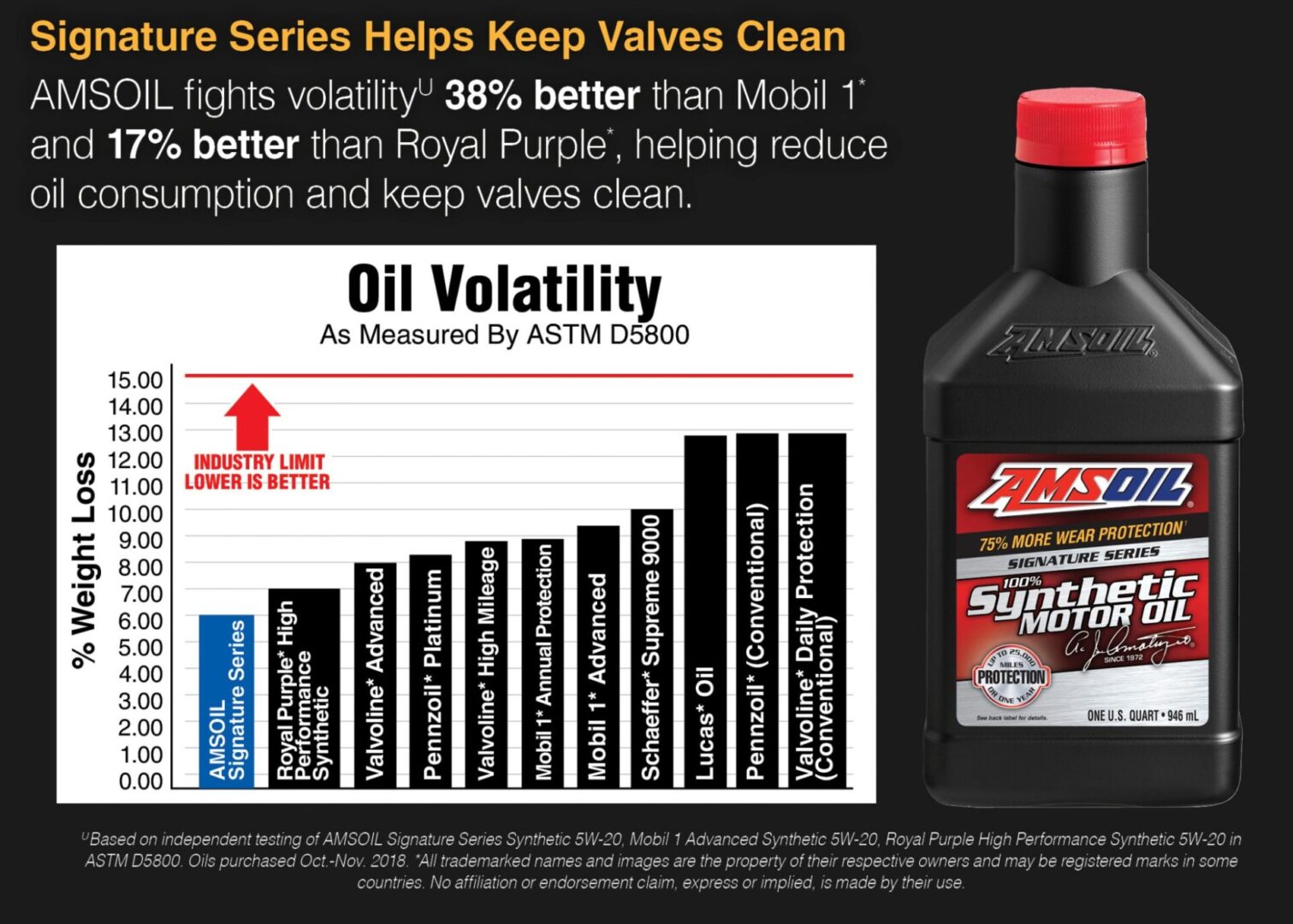
ASTM D5800 results can vary by viscosity grade and formulation. A result published for one 5W-30 should not be applied to a manufacturer's 0W-20, 0W-40 or another product line. Check the current technical data sheet for the exact oil being considered.
Start with the viscosity and oil specification required by the vehicle manufacturer. From there, select the AMSOIL product designed for the engine, operating conditions and intended oil-change interval.
Noack volatility is not normally printed on the front of an oil bottle. Check the manufacturer's current technical documentation.
Some manufacturers publish the result and some do not. A missing Noack number does not prove the oil failed the test. It only means the value is not listed in the document being viewed.
ASTM D5800 does not directly measure bearing wear, camshaft wear, timing-chain wear or cylinder protection.
Oxidation resistance and deposit formation require separate laboratory tests and engine sequences.
A low Noack result does not determine how long an oil can remain in service. Drain recommendations depend on the complete formulation, engine design and operating conditions.
Always use an oil that meets the engine manufacturer's required specification. A low-volatility oil with the wrong approval can still be the wrong oil.
ASTM D5800 provides a repeatable measurement of how much engine oil evaporates during controlled high-temperature testing. Lower evaporation loss can help reduce volatility-related oil consumption and limit changes to the lubricant left in the crankcase.
Use the result properly. Compare oils of the correct viscosity that meet the same required specifications. Do not use Noack volatility as a replacement for engine-oil approvals, full performance testing or mechanical diagnosis.
ASTM D5800 is the standard test method used to measure the evaporation loss of lubricating oils by the Noack method. The result is reported as a percentage of the original sample mass lost during the test.
Yes. ASTM D5800 is commonly called the Noack Volatility Test. It defines approved laboratory procedures for measuring lubricating-oil evaporation loss.
A lower result means less oil evaporated under the test conditions. That is better for volatility control, but the oil must still meet the viscosity and performance specifications required by the engine.
There is no single percentage that applies to every engine oil. Compare the result with the limit established by the required specification and with current data for comparable oils of the same viscosity grade.
It can help reduce the portion of oil consumption caused by evaporation. It cannot prevent consumption caused by leaks, worn piston rings, valve seals, crankcase ventilation faults or turbocharger problems.
Synthetic base oils can be formulated for strong volatility control, but the final result depends on the complete oil formulation. Check the published ASTM D5800 result for the exact product rather than assuming every synthetic oil performs the same.
No. ASTM D5800 measures the percentage of oil mass lost through evaporation under specified conditions. Flash point measures the temperature at which vapour can ignite under a separate test method.
Check the current Technical Data Sheet or Product Data Sheet for the exact product and viscosity. Look for Noack volatility, evaporation loss or ASTM D5800 in the typical-properties section.